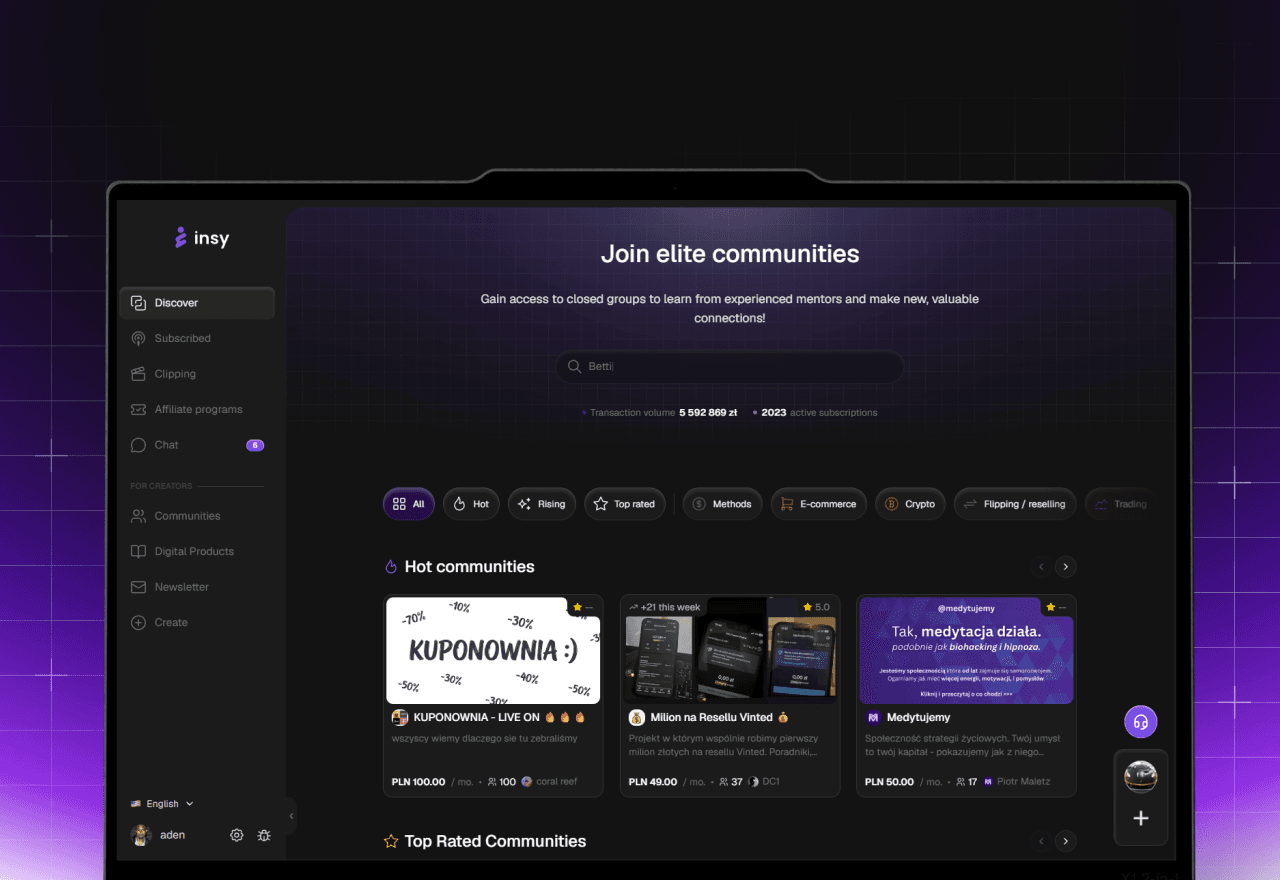
insy: infrastructure for paid creator communities
All-in-one social commerce for creators. Creators build private communities, people pay for access via Stripe. We built the entire infrastructure and scale it from day one.
- 150+
- Communities
- 25k+
- Monthly users
- 200k+ PLN
- Revenue since 01.2026
How it works
A creator sets up a profile, connects an account, sets a subscription price and decides what to share: posts, video, files, chat, live events.
Users browse the community catalogue, pick the groups they want and join through Stripe. Recurring payments, automatic renewal, predictable revenue for the creator.
insy.io settles commissions automatically and the money goes straight to the creator. The platform handles notifications, moderation, analytics and discovery, so the creator can focus on content.
Tech stack
SvelteKit
A fast, reactive and light framework that keeps page loads quick.
NestJS
A modular Node.js framework in TypeScript for business logic, authorization and integrations.
Go / Rust
For work that needs extreme performance: queues, event processing and I/O-bound operations.
PostgreSQL + Redis
PostgreSQL as the main database with advanced relational modelling. Redis for cache, sessions and real-time queues.
ArgoCD + Helm
Every change in the repository syncs to the cluster automatically through ArgoCD.
Infrastructure: clusters
insy-prod
The production cluster. It serves all user traffic, with no compromises on stability.
insy-stage
The staging cluster. A mirror of production where changes land and bugs get caught before users see them.
insy-fun
The dynamic cluster. It creates and destroys environments on demand for tests, devbox sessions for AI agents and validation.
Pipeline with AI agents
Push & draft PR
Changes made by an agent are pushed to devbox branches and a draft PR is opened automatically.
CI/CD + the fun cluster
Tests run and the insy-fun cluster spins up a temporary environment for the current changes, so the agent's work can be tested.
Code review & feedback loop
Code review can trigger a feedback loop: the agent iterates on the comments until the change is ready to merge.
How we built it
Research into the market, the competition and what users need. Conversations with community creators and a defined scope.
System design, stack selection (SvelteKit + NestJS + Go/Rust), wireframes and a prototype to test. From day one a mix of hand-written code and AI agents.
A declarative NixOS server is the brain of the whole infrastructure and every cluster talks to it. It runs Vaultwarden (secrets), Dex (single sign-on) and Headscale. Every agent gets an isolated environment identical to the one our technical team uses.
Building something similar?
Tell us about your project and we will get back to you with specifics.